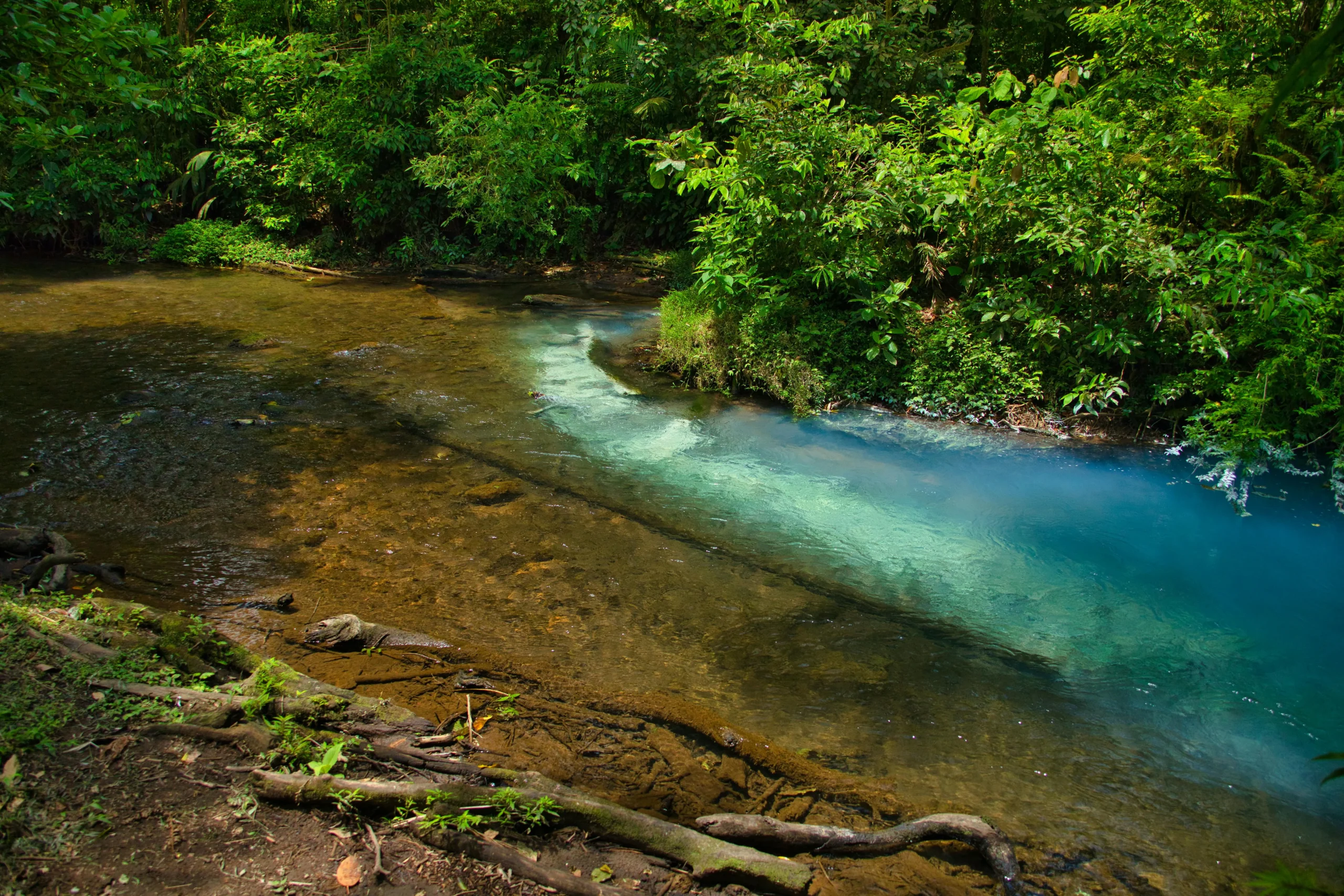
Deep in the heart of the Tenorio Volcano National Park lies a visual paradox that has baffled travelers for centuries. At a precise point known as Los Teñideros (The Dyers), two crystalline streams collide, and as if by alchemy, the water instantly transforms into a brilliant, opaque turquoise. This isn’t a result of chemical dyes or divine intervention, but a fascinating display of volcanic chemistry and optical physics. While local folklore suggests God washed his brushes here after painting the sky, the reality is far more complex, involving a specific concentration of 12.6 milligrams per liter of aluminum and a rare physical phenomenon known as Mie scattering.
The Legend Meets the Laboratory: Moving Beyond the Myth
For decades, the standard explanation for Rio Celeste’s hue was a vague reference to sulfur or volcanic minerals. However, a 2013 study by the University of Costa Rica (UCR) and the National University (UNA) debunked the idea of a chemical dye. There is no blue pigment in the water. Instead, the Teñideros serves as a natural laboratory where geology and physics intersect to create a permanent optical illusion. Unlike other “blue” rivers that rely on high glacial silt or specific algae, Rio Celeste depends on the sudden transformation of mineral particle size at a single, violent mixing point.
The blue you see is not a substance; it is a specific frequency of light reflected back to your eye by particles that didn’t exist seconds before the streams met.
The Anatomy of a Confluence: Identifying El Teñidero
The “Teñideros” represents the exact geographic coordinates where the Quebrada Agria and Río Buenavista meet. To the naked eye, it looks like a line in the water: clear on one side, electric blue on the other. This isn’t a gradual fade but an immediate transition occurring within centimeters of the confluence. When hiking the main trail, this point is the furthest accessible reach of the path, marking the start of the river’s celestial journey. The clarity of the upstream tributaries makes the sudden opacity of the main river feel even more alien.
| Feature | Quebrada Agria (Sour Creek) | Río Buenavista |
|---|---|---|
| pH Level | 3.1 (Highly Acidic) | 6.8 (Near Neutral) |
| Primary Minerals | Aluminum, Sulfur (Volcanic Acids) | Silica (Diatoms), Bicarbonates |
| Visual State | Clear / Transparent | Clear / Transparent |
| Primary Role | Aluminum Source & Acidifier | Silica Source & Neutralizer |
The First Ingredient: Rio Buenavista’s Mineral Wealth
The Río Buenavista is a crucial contributor to the “secret ingredient.” It flows through volcanic soils, carrying dissolved silicon and microscopic aluminosilicates—specific compounds of aluminum, silicon, and oxygen. Despite this mineral load, the river remains perfectly transparent. This is because the water’s pH is near neutral, which keeps the mineral particles in a dispersed, microscopic state. At this stage, they are far too small to reflect the visible light spectrum, allowing light to pass through the water without scattering.
Research indicates that the silicon concentration here is roughly 25 milligrams per liter, while the intersecting Quebrada Agria provides the necessary aluminum (roughly 12 milligrams per liter). This specific balance is the “sweet spot.” If the concentrations were lower, the blue would be faint; if higher, the river would likely appear milky or white rather than the vibrant turquoise that defines the Overview of the region’s beauty.
The Second Ingredient: The Acidity of Quebrada Agria
Sourced directly from the volcanic veins of the Tenorio complex, Quebrada Agria (Sour Creek) provides a crucial component. It is highly acidic, with a pH of 3.1 due to volcanic sulfur and sulfur-oxidizing bacteria. You can actually smell the faint scent of sulfur as you approach this stream. While older theories claimed it merely carried the high acidity required to “shock” pre-existing minerals flowing in from the neighboring Buenavista, recent science reveals Quebrada Agria is actually the main source of dissolved aluminum. It chemically reacts with the silica from the Buenavista to form the blue-scattering particles. Without this reaction, the rivers would simply remain clear streams.
The Chemical Trigger: The pH Shock at the Mixing Chamber
The transformation is a “pH-induced aggregation” event. When the acidic water of Quebrada Agria hits the neutral water of Río Buenavista, the sudden drop in pH causes the aluminosilicate particles to aggregate—they clump together. This forms a specific compound known as hydroxyaluminosilicate. These minerals don’t change their chemical color; they simply grow in physical size. This occurs almost instantaneously in what researchers call the “mixing chamber” of the confluence. It is a violent, invisible collision of ions.
It is not a pigment. The blue you see is a trick of the light caused by the physical size of the mineral particles reaching exactly 566 nanometers.
The 566-Nanometer Threshold: The Physics of Blue
Once the aluminosilicate particles expand to their new size, they reach a diameter of approximately 566 nanometers. This is the “Golden Ratio” for light. At this exact size, the particles trigger **Mie Scattering**. While the rest of the light spectrum (reds, yellows, and greens) is absorbed by the water or passes through, the shortest wavelengths—the blues and violets—are scattered back toward the surface with high intensity.
This explains why the river is blue only at this junction and downstream. The particles must be exactly this size to reflect that specific hue. If you take a bottle of Rio Celeste water home, it will eventually lose its brilliance as the particles settle or further aggregate, proving that the color is a dynamic state of suspension. This phenomenon is also why heavy rain can ruin the view; the introduction of mud and sediment disrupts the scattering and turns the water a dull, opaque brown.
The Mirror Effect: The Role of White Sediment
There is one final piece to the optical puzzle: the riverbed. If you look closely at the rocks at the bottom of Rio Celeste, you will notice they aren’t blue at all. They are coated in a heavy, creamy-white layer of aluminosilicate sediment. This white “backdrop” acts as a reflective mirror. As the blue light is scattered by the suspended particles in the water column, the white rocks reflect that light back up through the water, doubling the intensity of the color. It’s a natural light-box effect that makes the turquoise appear almost neon in the midday sun.
Experience the Phenomenon in Person
To see this chemistry in action, you must visit during the dry season when the pH levels and mineral concentrations are at their most stable. It is a three-mile trek to the Teñideros, often through muddy terrain that requires proper hiking gear. Below are the best ways to explore the park with expert guides who can point out the chemical markers of the river.

Rio Celeste Waterfall Hike from Arenal
⭐ Professional local guide included
🔥 Booked 10 times this week

Tubing in Rio Celeste
⭐ Professional local guide included
🔥 Booked 11 times this week

La Fortuna: Mistico Park Hanging Bridges Guided Tour
⭐ Professional local guide included
🔥 Booked 12 times this week

Tour / Night Walk La Fortuna
⭐ Professional local guide included
🔥 Booked 13 times this week

Safari Float and wild life experience in Arenal
⭐ Professional local guide included
🔥 Booked 14 times this week

La Fortuna Arenal Bird Feeder Station and Butterfly Garden
⭐ Professional local guide included
🔥 Booked 15 times this week
Scientific Frequently Asked Questions
- Is the blue water caused by a chemical reaction or a physical one? It is a sequential combination of both processes. A chemical reaction (the sudden pH change upon mixing to roughly 5.0) causes dissolved minerals to precipitate and clump together, which then creates the physical conditions necessary for Mie scattering to reflect blue light.
- Does the water stay blue during the rainy season? Heavy rainfall can significantly dilute the mineral concentration and introduce volcanic mud from the banks, which physically blocks light from scattering. You should check the Best Time to Visit guide to understand how rainfall in Upala affects the river’s clarity.
- Is the water toxic because of the volcanic acidity? While the Quebrada Agria is highly acidic at pH 3.1, the combined flow of the Rio Celeste stabilizes to a safer, though still slightly acidic, level. However, swimming is strictly prohibited within the national park to protect the delicate mineral balance and ensure visitor safety.
- Why isn’t the whole river blue from the start? The blue color requires specific components that are geographically separated until the confluence. Recent research shows that dissolved aluminum and silica are primarily in the acidic Quebrada Agria, while the neutralizing trigger is in the Buenavista; they must meet to precipitate and reach the 566nm particle size.
- What exactly are aluminosilicates? They are a group of minerals composed of aluminum, silicon, and oxygen that are abundant in the volcanic soil surrounding the Tenorio Volcano. These minerals are highly reflective once they aggregate to a specific size, making them the primary “reflectors” in the water.
For those interested in the broader ecosystem surrounding this chemical marvel, our Wildlife & Nature Guide explores the rare species, such as the Baird’s Tapir, that drink from these mineral-rich waters. If you are planning your trip from the coast or the capital, ensure you review the transportation logistics for navigating the rugged roads to Bijagua.